- Product
- RelayKit
- Focus
- WordPress and API Engineering
- Audience
- WooCommerce stores, WordPress agencies and integration teams connecting paid orders to external service providers.
- Evidence
- Working demo, source and tests
What this system solves
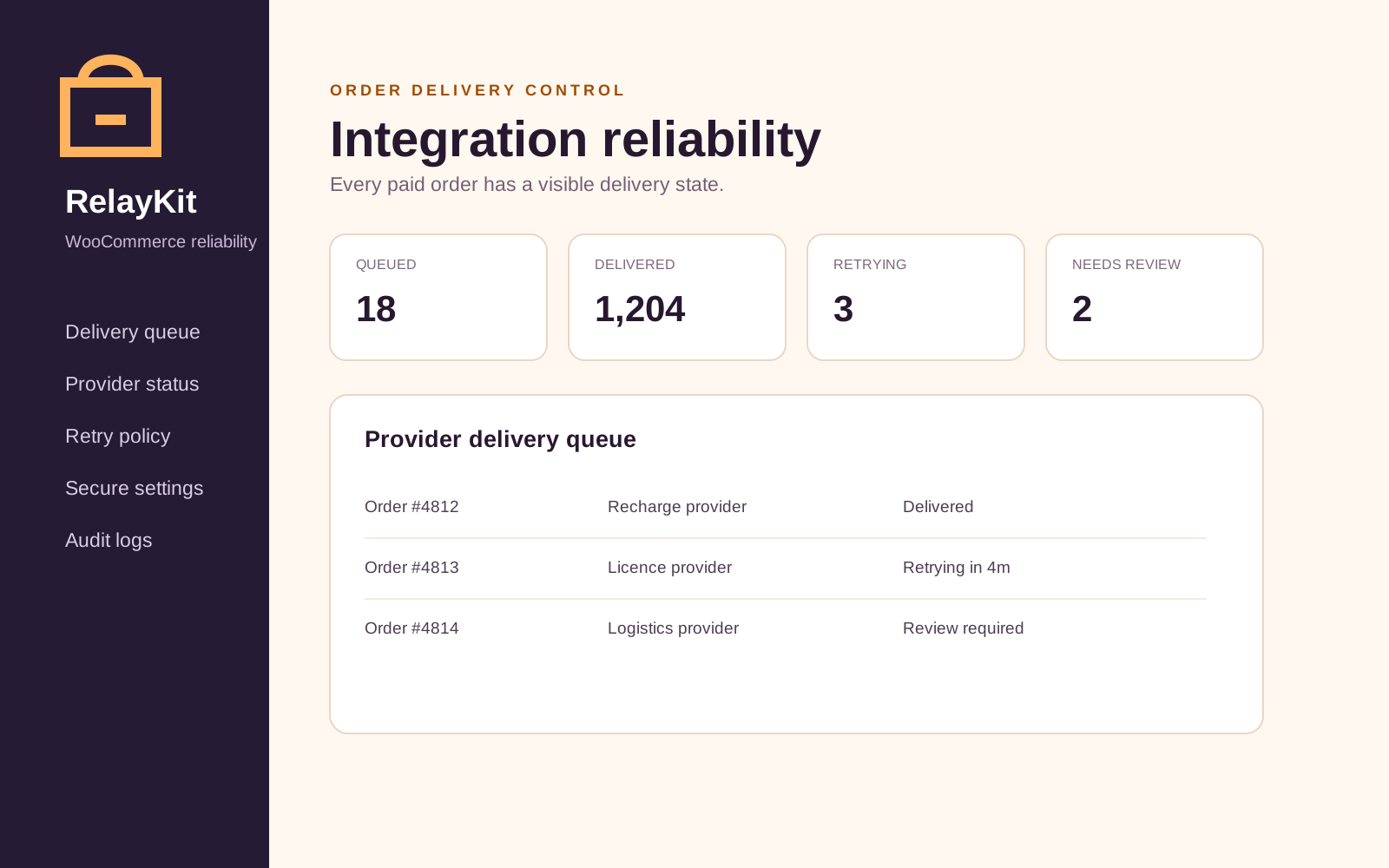
RelayKit demonstrates how a paid WooCommerce order can reach an external fulfilment, licence, recharge or logistics provider without depending on one fragile API request. Deliveries are stored before transmission, assigned stable idempotency keys and moved through visible recovery states.
WooCommerce stores, WordPress agencies and integration teams connecting paid orders to external service providers.
My role
I built the installable plugin, delivery state model, signing and secret-handling utilities, scheduling strategy, administrative recovery flow, tests and safe browser demonstration.
Capabilities demonstrated
- WooCommerce paid-order lifecycle hooks
- Persistent delivery records and stable idempotency keys
- HMAC-SHA256 request signing
- Encrypted provider secrets
- Action Scheduler processing with WP-Cron fallback
- Bounded retries, redacted logs and manual recovery
System flow
Important decisions
The plugin does not claim impossible exactly-once transport. It models at-least-once delivery with stable idempotency, persists intent before external side effects and stops retrying errors that are unlikely to recover.
Beyond the happy path
Temporary errors use exponential retry scheduling with jitter and a fixed attempt ceiling. Permanent failures remain visible, and manual retries require WooCommerce management capability plus a valid nonce.
Testing and evidence
Portable policy tests cover retry classification, redaction and recovery rules. Browser records and provider responses are synthetic.
Current limitations
GitHub Pages runs only the static demonstration. It does not execute PHP or WordPress. The repository contains the installable plugin for local WooCommerce review.
Production extension path
Production adoption requires provider-specific payload mapping, hosting-appropriate key management, retention controls, monitoring and end-to-end sandbox verification.
Tools and concepts
Let’s work together
Building something that needs to work beyond the happy path?
I help teams turn complex product, integration and reliability requirements into clear, maintainable software.