Company knowledge and policy search Interactive prototype
KnowledgeOps
The cost of a missing answer is often the interruption it creates for the one person everyone knows to ask.
The problem
As teams grow, the same questions return.
Policies, approval rules and operating instructions can spread across folders, chat threads and old documents. A new colleague may find several versions of an answer but cannot tell which one applies now. Experienced staff become the informal search engine, and a decision made from an outdated document can create more work later.
Who it may help
A focused workflow for a specific team.
Growing operations, HR, support and service teams that repeat policy questions or need a clearer owner for internal guidance.
Picture a typical workday.
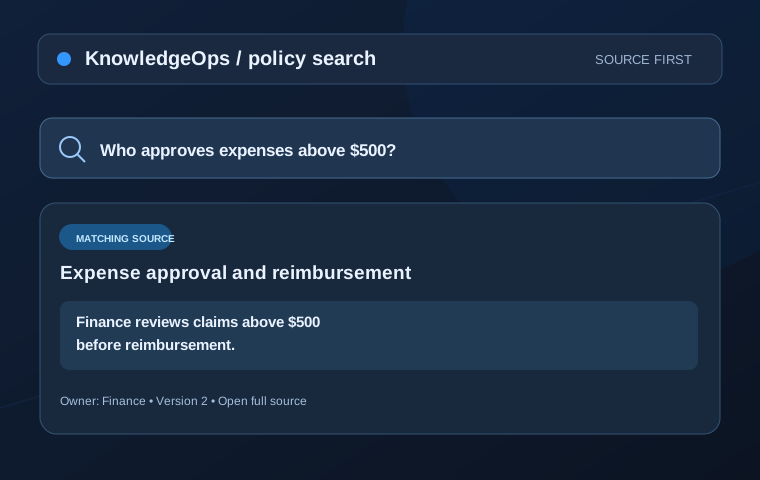
A new team member needs to know who approves a large purchase. Instead of interrupting three people, they look up the policy, see the relevant passage and identify who owns that document. If the rule appears outdated, they can flag it for review rather than treating an uncertain answer as settled.
What we want to learn
What could improve if this fits your process?
- Find the right sourceBring an answer back to a document a person can check.
- Know who can clarifyMake ownership visible when a rule is ambiguous or stale.
- Protect team attentionReduce repeat questions that draw experienced staff away from their work.
These are possibilities to test with real teams, not measured customer outcomes.
Current stage
An experiment with clear boundaries.
The current prototype searches fictional local text. It does not use an AI answer service, import real company documents, provide single sign-on or enforce secure document permissions.
The same question asked in four channels
A growing company updates its supplier onboarding policy. Sales has an older PDF, operations has a newer document, and new hires ask the one manager who remembers the change. KnowledgeOps explores how staff could find an answer with a source and document owner, then flag uncertain or outdated information for review. It should support human judgment, especially when a policy has legal or financial consequences.
Where to start
Which recurring question interrupts the same person every week?
In a free pilot we could use a small set of safe example policies and ask employees to find several answers. We would watch where source links, ownership and update dates help or fail to build trust.
Free guided pilot
Try the idea against your own workflow.
We can choose a small set of sample procedures, test the questions people actually ask and learn whether the result feels trustworthy. Any future use of internal documents would need agreed access and governance.
There is no fee and no obligation to adopt it. The goal is to learn what works, what does not and what your team would need to use it comfortably.