Record comparison and exception review Working prototype
SourceCheck
When two systems disagree, someone still has to decide which record to trust.
The problem
A mismatch can become a customer mistake.
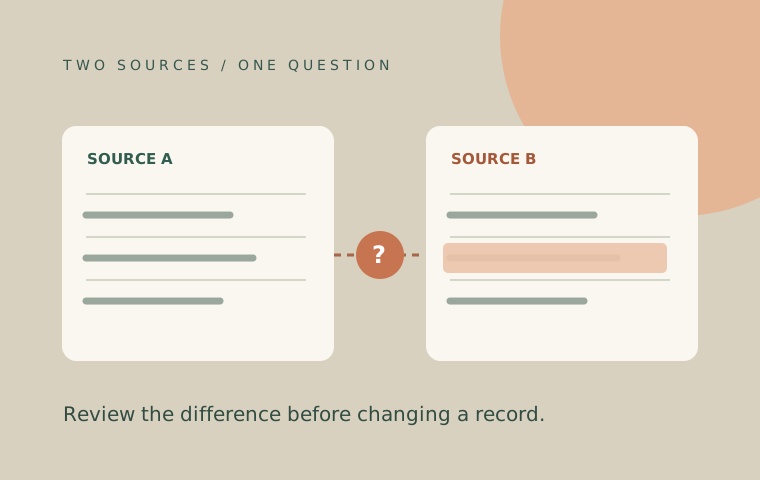
A CRM says a client is active while a service register says inactive. Two teams may each have a recent-looking spreadsheet, yet no one knows whether one record is late, duplicated or genuinely different. Acting on the wrong row can lead to a poor message, a missed follow-up or a mistaken operational decision.
Who it may help
A recognizable operating problem.
Customer operations, service organizations, finance administration and teams exporting records from two tools that do not share a reliable source of truth.
Picture the handoff.
A service manager prepares an outreach list. One customer has different statuses in the CRM and delivery register. Another has the same email but a different ID. SourceCheck surfaces both cases, shows the original rows and leaves the identity question for a person to review.
What we want to learn
What could improve if it fits?
- Find discrepanciesFlag duplicate IDs, missing rows and differing status or contact fields.
- Keep the source beside the questionInspect each original row and the rule that caused the exception.
- Record human judgmentSave a reviewer decision and reason, then export an exception report without changing the source files.
These are outcomes to test with teams, not measured results from customers.
Working scope
What you can try today.
The working browser demo starts with two fictional CSV snapshots. You can import two small CSVs, map their columns, compare records, filter the exception queue, record decisions and export JSON. Files are processed in the browser during that session. No source database is updated and possible matches remain unconfirmed.
Try it yourself.
- Run the preloaded comparison and open the customer status conflict.
- Inspect a possible match where the name or email agrees but the identifier differs.
- Record a review reason, filter the queue and export the report.
Engineering evidence
The implementation behind the demo.
JavaScript CSV parser, configurable column mapping, deterministic ID comparison, candidate suggestions, review interface, JSON export and automated tests.
The linked repository includes the code, local setup instructions and automated tests. The GitHub Pages site runs the safe browser demonstration.
Pilot boundary
What the demo does not prove.
The demo is limited to two CSV files of up to 1 MB and 500 rows each. It does not establish identity from a name or email, determine the authoritative source, synchronize tools or retain reviews after refresh.
A production integration would need authenticated access, retention controls, source ownership, agreed matching rules and an audit trail.
Free guided pilot
Test one case with your team.
Start with invented records that mirror a familiar discrepancy. Your source owners can assess whether the proposed queue exposes the right questions before discussing secure access to live records.
No fee and no obligation to adopt. A production build would be discussed and scoped separately.