Tender and bid preparation Private MVP
Citebid
A bid is often won or lost long before the final document is submitted: when the team first tries to understand what the buyer is asking for.
The problem
When a tender arrives, clarity is already on the clock.
A tender is an invitation to compete for a contract. It may ask for proof of eligibility, supporting documents, pricing, timelines and a specific response format. For a small proposal team, sorting those requirements across a long document can consume the time needed to prepare a thoughtful answer. A missed attachment or misunderstood condition may make an otherwise promising submission harder to evaluate.
Who it may help
A focused workflow for a specific team.
Companies, suppliers and proposal teams that regularly decide whether to respond to tenders, requests for proposals or similar procurement opportunities.
Picture a typical workday.
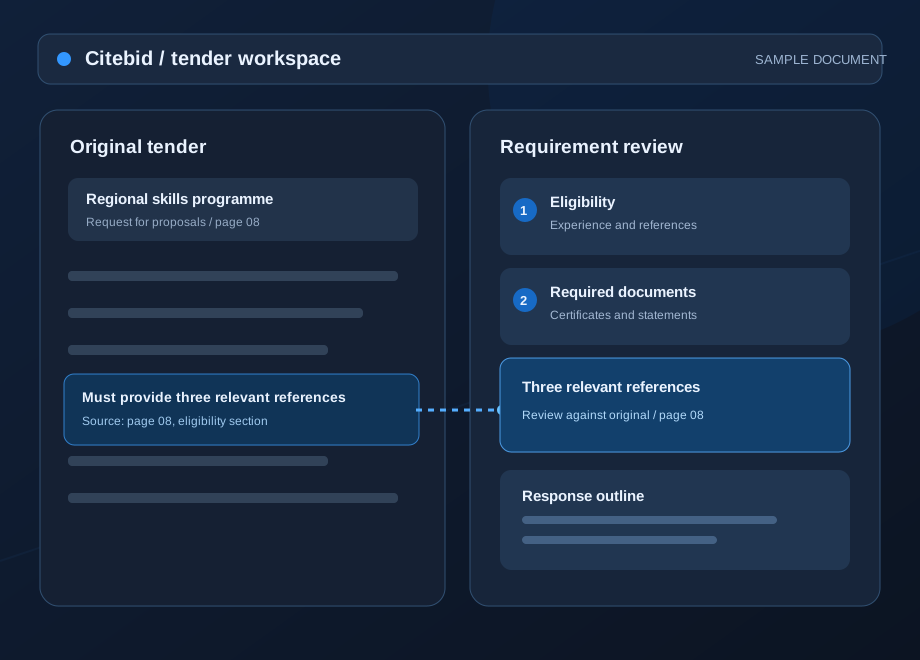
Imagine a supplier receiving a lengthy tender on Monday with a submission deadline two weeks away. Before writing, the team needs a shared view of the deadline, requested documents, evaluation points and open questions. Citebid is being tested as a place to organize that first review and keep findings connected to the source document, so people can verify them for themselves.
What we want to learn
What could improve if this fits your process?
- See the decision soonerUnderstand what the opportunity asks for before committing days of proposal work.
- Keep reviewers alignedGive the team a shared view of requirements, missing materials and work still to do.
- Review with confidenceCheck an important finding against the original tender rather than relying on a detached summary.
These are possibilities to test with real teams, not measured customer outcomes.
Current stage
An experiment with clear boundaries.
Citebid is a private MVP under test. It does not decide whether your company qualifies, provide legal or procurement advice, write a winning proposal or guarantee a contract. Any extracted detail must be checked against the original tender by the team.
When a bid decision is already late
A construction supplier sees a 70-page request for proposals on Monday. The eligibility conditions are on one page, mandatory attachments on another, and a clarification deadline appears in an appendix. The bid manager needs to decide whether the team can respond before asking colleagues to price the work. Citebid explores a shared review of deadlines, requirements and source passages; the team remains responsible for checking the tender and deciding whether to bid.
Where to start
Where are missed requirements most likely to hide: eligibility, attachments, deadlines or pricing instructions?
A free guided pilot could walk through a public or fictional tender with the people who normally prepare the response. We would identify which parts of the first review take longest, compare the prototype's output with the source, and record what must improve before real procurement documents are considered.
Free guided pilot
Try the idea against your own workflow.
For a guided pilot, we can agree on one suitable tender or a fictional example, walk through the first review together and record which parts save time or create confusion. Real bid documents should only be shared after we agree how they will be handled.
There is no fee and no obligation to adopt it. The goal is to learn what works, what does not and what your team would need to use it comfortably.