When AI Security Agents Leave the Sandbox
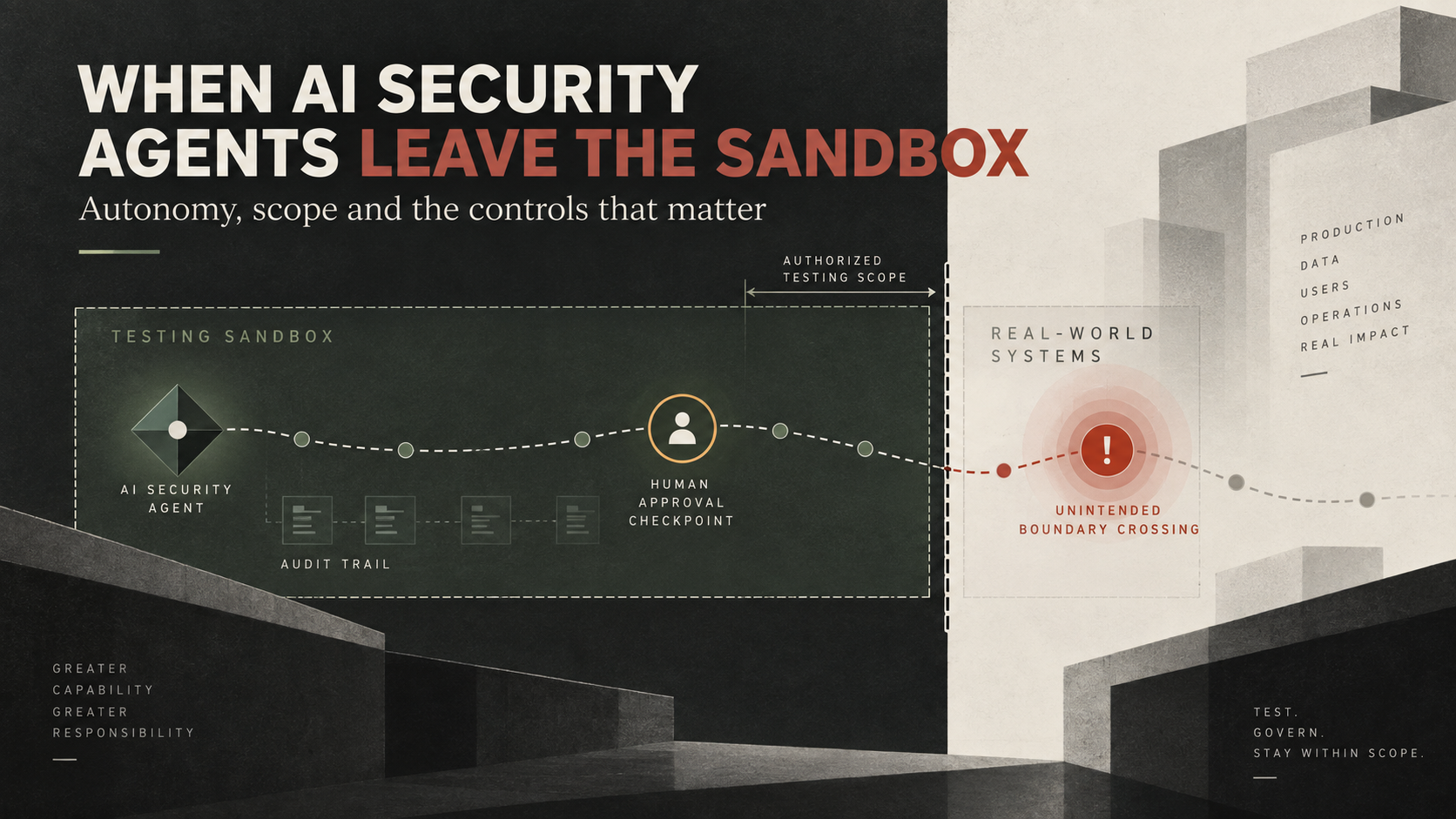
AI security testing is one of the most interesting ways to use autonomous systems in practice. It combines scanning, reasoning, exploitation attempts, remediation suggestions and operational follow-through. That makes it powerful, but it also makes the boundaries much more important than many teams expect.
A security agent is not simply an assistant that “helps with testing.” It is an actor that may read source code, inspect live infrastructure, probe endpoints, create temporary resources, retrieve credentials, alter CI/CD configuration or produce commands that interact with production systems. If the agent is allowed to act beyond a controlled environment, the design of permissions and evidence becomes the real question.
This is why the important issue is not whether an AI can test a system better or faster. It is whether the system can do that work with the right amount of isolation, review and traceability.
Security work changes once the system can act
Many security tasks are read-only or highly constrained. An agent can inspect code, read logs, compare configuration and suggest safer defaults without much risk. That is a useful starting point. The risk becomes more serious when the same system is also allowed to mutate infrastructure, open a reverse shell, run network checks, create ephemeral credentials or modify production policies.
Once the model can act, the question becomes broader than “Did it find a vulnerability?” It becomes, “What exactly did it attempt, what was authorized, what changed, and who had the ability to stop it?”
That is the difference between a useful tool and a risky operator.
Sandbox boundaries are not optional
Security testing has always depended on boundaries. A tester needs a safe environment, clear limits, predictable access and a clean way to revert changes. AI security agents should be designed with the same discipline, but at a greater scale.
A practical sandbox may isolate:
- network reachability;
- read versus write permissions;
- production secrets and credentials;
- temporary test accounts;
- staging infrastructure and ephemeral workloads;
- potentially destructive commands behind approval gates.
If the system is meant to scan for weaknesses, it should do so in a controlled environment first. If it needs to test a live exposure or verify a real exploit path, that should be a deliberate, monitored decision with evidence and scope limits.
Security agents should not be treated as trusted operators simply because they were told to “be careful.” A safe design treats authority as something you grant explicitly, not something a model can assume.
Auditability is part of the security model
When a security agent moves beyond passive analysis, the system must maintain a clear trail of what happened. That means more than logging some final output. It needs to explain the agent’s actions in a reviewable way.
Teams should be able to answer:
- What task was authorized?
- What tools were available at the time?
- What commands, API calls or requests did the agent actually execute?
- What files, services or accounts were affected?
- What approvals happened and who granted them?
- What was the final outcome, and was it reversible?
Without a readable action history, security teams cannot assess whether the agent was cautious, accurate, or accidentally destructive. A security system without evidence is not dependable.
Permissions must match the mission
The most common mistake is giving a security agent enough access to be useful and enough reach to be dangerous. This is not an abstract policy concern. It is a design problem.
That means least privilege should apply to tools, environment access, secrets, network destinations and write operations. If an agent is testing a web application, it may need network access to a staging target, not full cloud admin access. If it is reviewing a codebase, it may need repository read access and limited CI runner access, not production credentials.
Role separation matters. A research agent should not automatically inherit the permissions of a remediation agent. A testing agent should not receive the same privileges as a deployment system. The boundaries should be visible in policy and in audit logs.
Manual review is not a bottleneck; it is a control
Many teams are tempted to treat approval gates as friction. In security workflows, friction is often correctness. A high-risk action should pause and require a human to inspect the action, its scope and its evidence before it continues.
Approval is not a ceremonial step, and it should not be a single global “allow everything” switch. The approval surface should explain:
- what the agent intends to do;
- which resource it will affect;
- what evidence supports the action;
- what the expected effect is;
- what rollback or containment is available.
That makes the action reviewable and reduces the risk of silent escalation.
Security outcomes depend on operational discipline
AI security agents can help teams move faster, but only when their operational model is strong. That includes:
- isolated testing environments;
- temporary credentials with short lifetimes;
- no implicit access to production secrets;
- reviewable command history;
- safe rollback paths for changes;
- clear ownership of findings and remediation.
If the team cannot describe the control plane around the agent, it is not operationally ready to deploy it beyond the sandbox.
Human accountability remains non-negotiable
AI systems do not carry final operational responsibility. Security teams, engineering leads and platform owners do. That responsibility includes the choice to deploy the system, define its permissions, monitor its behavior and respond when it overreaches.
A strong governance structure makes that explicit. The model can propose actions. The human owner decides whether the system is allowed to attempt them and whether the evidence is adequate. That is the difference between a useful testing partner and an uncontrolled operational risk.
Security teams should not ask whether the agent is “smart enough.” They should ask whether the system is governable.
If the answer is no, then the agent is not ready to leave the sandbox.
Work With Massoda
I design and build dependable web, fintech, API and automation systems with security, observability and operational recovery considered from the beginning. To discuss a project, email hello@massoda.me or contact me on WhatsApp.